
TL;DR: We tracked six AI models (ChatGPT-class, Claude, Gemini, Perplexity, and others) across 2,520 real search queries in the dental care sector, in 14 Italian cities. Only 18.6% of brands got cited by every single model. The rest is fragmented, unclaimed, and wide open.
We picked dentistry on purpose. It’s not a consumer category like sneakers or headphones. It’s a credence service: something you can’t judge before you buy it. You ask who’s good, who’s affordable, who you can trust, and an AI answering that question carries real weight.
Nobody has optimized for this yet. That’s exactly why it’s the right place to start, and why the pattern we found should replicate across dozens of similar local service sectors.
How many brands actually get cited by every AI model?
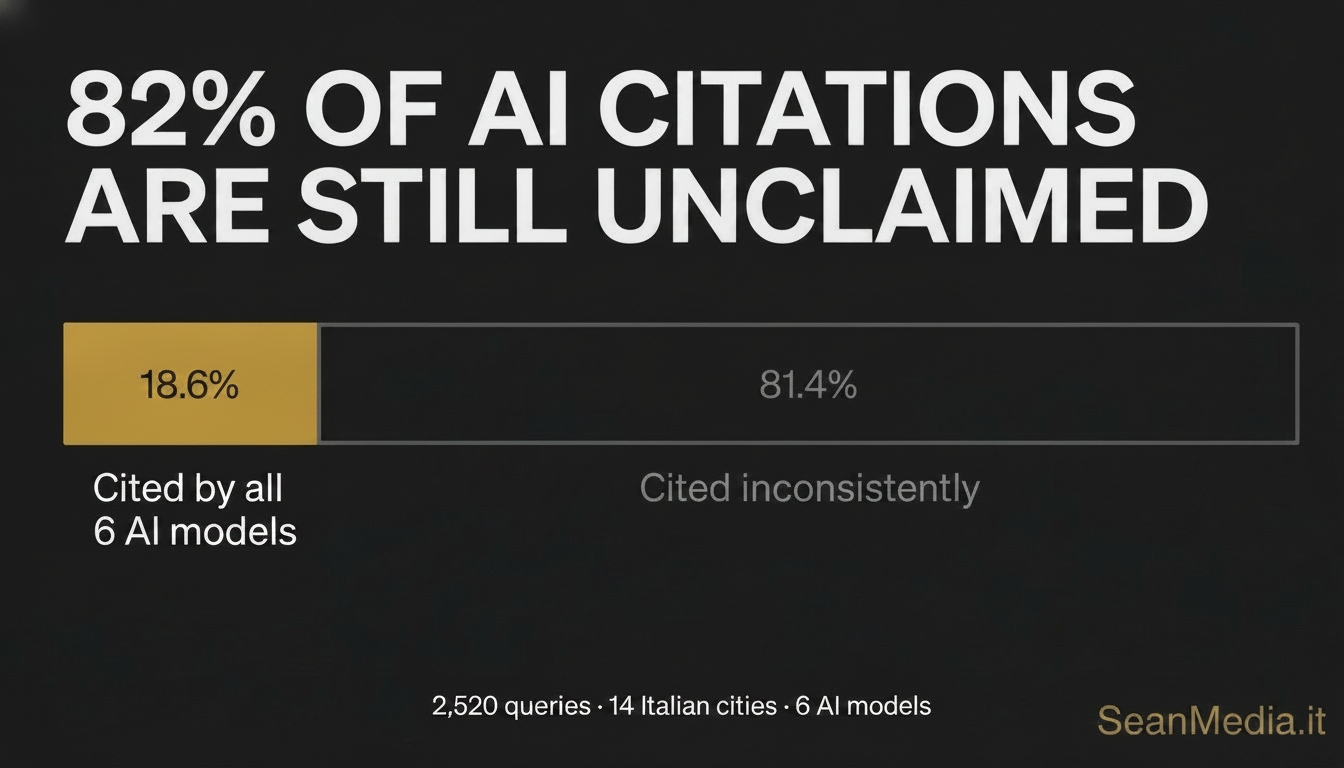
Only 18.6% of brands get cited by all six models we tracked. Everyone else is visible to some AIs and invisible to others.
We ran 10 real-world prompts (cost questions, urgency questions, trust questions) across 6 AI models, 3 times each, in 14 cities. That’s 2,520 individual queries.
Out of every 100 dental brands mentioned, only 18 show up no matter which AI you ask. The other 82 are only partially visible, cited by two, three, maybe four models out of six.
Which model diverges the most from the others?
Perplexity, not Gemini, shows the highest divergence, averaging 8.7 exclusive citations per city against Gemini’s 5.2.
We expected the Google-backed model to be the outlier, since it likely draws on a proprietary index. It isn’t. Perplexity, which runs its own independent search index, diverges more consistently across every city we tested.
Models sharing the same underlying search backend tend to converge on the same citations. Models with independent indexes diverge, and that divergence isn’t small.
Why does this fragmentation matter for your business?
Low convergence means no one has consolidated the market yet, and that window won’t stay open forever.
In SEO, the first page of Google has been locked in for years. Getting in means displacing someone who’s been there since 2015. This is not that.
When only 18% of brands are cited everywhere, it means 82% of the visibility is still up for grabs. Whoever structures their content correctly now claims ground that competitors haven’t even started fighting for.
This won’t last. As more businesses catch on to GEO, the fragmented 82% will start consolidating, the same way Google search did fifteen years ago.
Is three runs per city enough to trust these numbers?
For small cities, yes. For large ones, probably not, and we’re saying so directly.
In Torino, Gemini’s citations spread across 69 different brands. In Nocera Inferiore, a much smaller city, they concentrated on just 26. Fewer competitors means the pattern stabilizes faster, and three runs are enough to see it clearly.
In large, competitive cities, a wider spread across more brands likely means our sample size understates how concentrated the real pattern actually is. We’re flagging this as a limitation, not hiding it.
What does this mean if you’re not cited yet?
It means you’re not late. You’re early, and that’s rare in digital marketing.
Earned media is doing most of the work here, third-party directories, review platforms, local listings, not brand-owned websites. A brand’s own site is structurally capped in how much citation share it can capture alone.
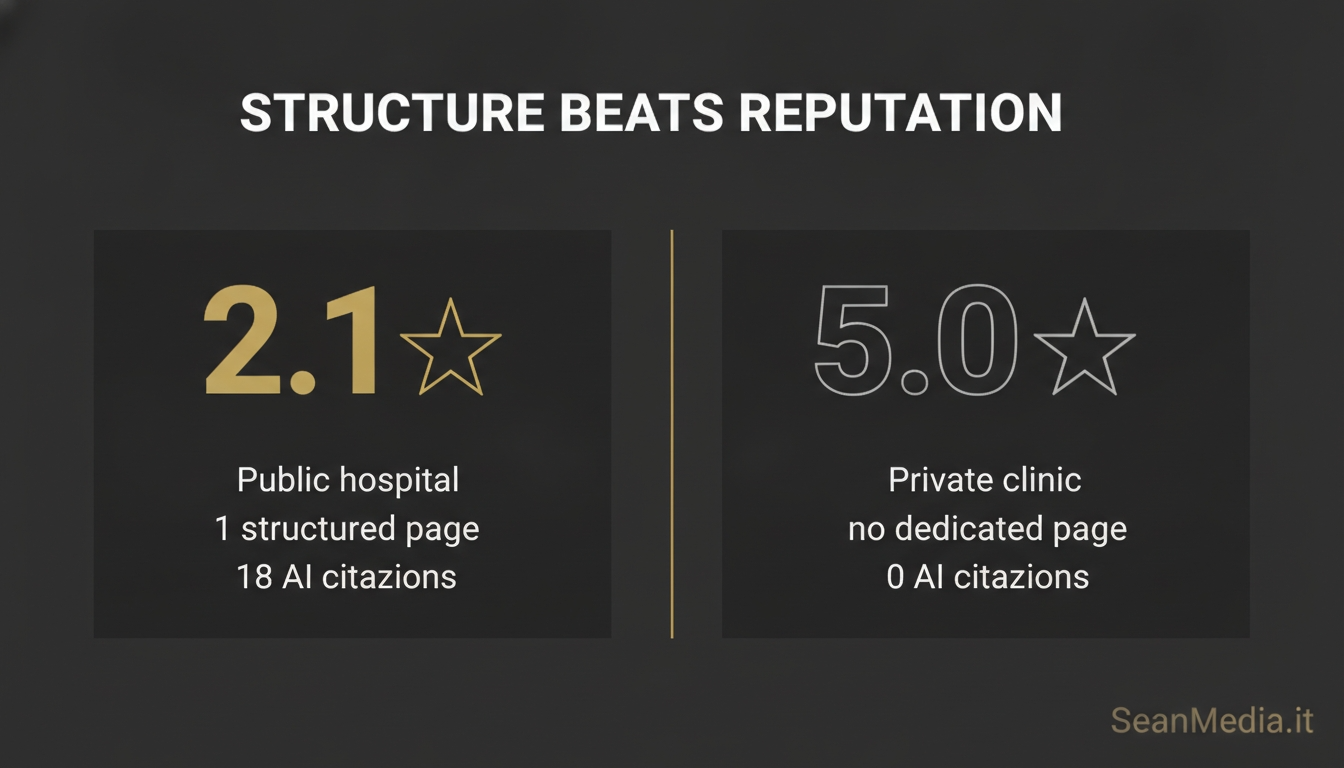
One case stood out across our dataset: a public hospital in Bologna, rated 2.1 stars on Google, received 18 citations across five AI models because it had a single, well-structured page for emergency dental care. Private clinics rated 5.0 stars with no equivalent page got zero citations.
Even more telling: chains with multiple locations in the same city, but a single national website with no dedicated page per location, often received zero citations for that city entirely, even when a competing single-location studio nearby was cited repeatedly. Having a physical presence isn’t enough. The AI needs a page that speaks to that specific location.
Structure beats reputation, and structure beats size. That’s not a theory, it’s what happened in the data, across 14 cities, 2,520 queries.
Frequently Asked Questions
What’s the goal of this study?
To understand how AI models behave in Italian-language searches. International research has shown patterns in English-language, consumer-brand contexts. We wanted to verify whether the same holds true in Italy, and extend that research to specific local service sectors.
Why did you choose dentistry for this study?
Dentistry is a credence service: quality is hard to judge before you buy, so people genuinely ask AI for recommendations based on trust, price, and reputation, making it a clean test case for AI citation behavior.
Can these findings apply to other industries?
Yes. The methodology and fragmentation pattern likely apply to any local service where the choice depends on trust rather than product specs, from legal services to home repair.